Introduction
Name, definition, object, importance, and division of Ontology (Fundamental Metaphysics) as the philosophical science of being as being.
Ontology (Fundamental Metaphysics) is the science of being as being — it investigates what is common to all real things precisely as existing, abstracted from all limiting determinations. Its formal object is ens qua ens (being as such); its material object is all real being. It is the most universal and fundamental of the philosophical sciences, studying the concepts (being, unity, truth, goodness, substance, cause) that underlie all other sciences. Three Books: Book I (the concept of being and its primary real divisions — act/potency, essence/existence); Book II (the transcendental properties of being — unity, truth, goodness, beauty, perfection); Book III (the categories — substance and accidents — and the four Aristotelian causes). Ontology is the capstone of speculative philosophy and the necessary preparation for Natural Theology.
INTRODUCTION
- Name 2. Definition 3. Object 4. Importance 5. Division
I. NAME
The name ontology is made up of two Greek words, to wit, on (stem ont-; combining form onto-) which means “being,” and logos which is used in compound words to signify “science.” Thus the term ontology literally means “the science of being.”
The word being is both a participle and a noun. We find it used as a participle in the sentence, “Being in an agony, he prayed the longer”; we find it used as a concrete noun in the line, “A being breathing thoughtful breath,” and as an abstract noun in the statement, “Philosophers discuss the questions of being and becoming.” In ontology the term being is regularly used as a noun, and most frequently as an abstract noun.
Ontology is sometimes called General Metaphysics, but the terms are not strictly synonymous. Ontology is properly a department of metaphysics, but it includes part of what is known as General Metaphysics and part of what is called Special Metaphysics. We shall accurately determine its scope when we discuss its definition. We call it Fundamental Metaphysics rather than General Metaphysics.
The term metaphysics has a curious history, or, if the history be called in question, it must at least be said that an interesting legend explains the origin of the term. It is said that when Andronicus of Rhodes collected and edited the works of Aristotle, about the year 70 b. c., he grouped together Aristotle’s eight books on the natures of things in this visible world and very properly labeled them ta physika or “Studies on (material or bodily) Natures.” He placed after these studies,—and the Greek word meta means after, —the deep and abstruse studies of Aristotle on the nature and properties of reality in its most general aspects as it is found in non-material being and in non-material modes of being. The latter writings, for want of an accurately descriptive name, were labeled ta meta ta physika, that is, “Studies Placed After the Treatises on Material Natures.” So the term metaphysics (meta-physika) came into existence and use. Now, by almost miraculous good fortune, this name, which originated in the accident of an editor’s arrangement of books, suits perfectly the science to which it is applied. For metaphysics treats of that which comes after, or lies beyond, the separate objects grasped by the senses and the sciences which treat of such objects; it is the science which draws these objects,—bewildering as they are in number and variety, —into intelligible unities.
- DEFINITION
Ontology is the science of being as such and of created being in its fundamental classifications and its causes.
a) Ontology is a science. That is to say, it is a body of doctrine, set forth in a manner that is systematic, logical, and complete, and it presents reasons to justify its data and to evidence its conclusions. Ontology is a philosophical science,—it is part of philosophy, and indeed it is the very heart of philosophy,—because it searches out the very deepest reasons for each point of its doctrine, and does not rest satisfied with immediate or proximate reasons which serve the requirements of the non-philosophical, phenonemal, and experimental sciences. Ontology is a speculative (or theoretical or doctrinal) science, because it presents truth for the mind to possess as an enrichment and an illumination; thus it differs from practical sciences (or directive or normative sciences) which give the mind knowledge that leads directly on to action, to something-to-be-done as the normal fruit of what is scientifically known.
b) Ontology is the science of being. By being we mean reality. And by reality we mean whatever exists or can exist. Anything that now exists, or that has existed in the past, or that will exist in the future, or that can be thought of as existing even though it never actually existed and never will—any such thing is a reality, a thing, a being. Any such thing has being, that is, it jias existibility. Since ontology deals with being or reality, it belongs to real philosophy, and is distinguished from mental philosophy (Logic) which studies exactness in reasoning, and from moral philosophy (Ethics) which treats of the rightness of human conduct. Further, ontology deals with being in its most general, abstract, and fundamental phases, and hence does not engage directly in the investigation of bodily reality which is discussed in natural philosophy (Cosmology and Psychology) ; it is rather the science of non-bodily being, that is, of being as such, not as limited to the bodily order. It will be valuable to set down a diagram of philosophy and to notice the place of ontology among the philosophical sciences. (See the diagram below.) It will be seen from the diagram that we reject the division of philosophy introduced by Christian Wolff (1679-1755) add adopted almost universally since his time. Wolff made Cosmology, Psychology, and Theodicy, departments of special metaphysics. But Cosmology and Psychology, while they are philosophical sciences, are not metaphysical sciences; they belong to philosophical physics, not to metaphysics. We retain, with slight modification, the ancient Aristotelian division of philosophy, and assign to ontology (a science so named in comparatively recent times) part of general and part of special metaphysics. We feel justified in calling ontology fundamental metaphysics.
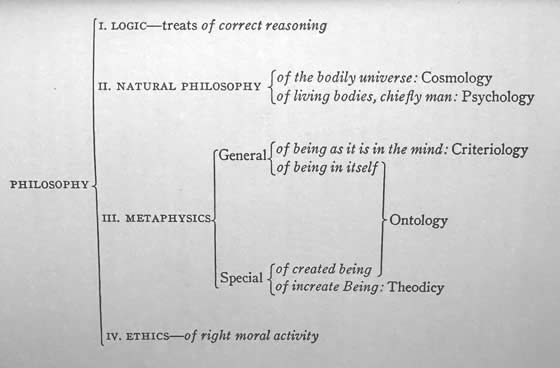
c) Ontology: is the science of being as such, or of being formally considered. The world about us is full of many and various bodily things. Add to these the realities that are non-bodily. Add to existing things, bodily and non-bodily, all things that could exist. The field of knowables thus surveyed, is seen to be overwhelming. Yet all these things are at one in this: they are all things; each of them is a something, a reality; each of them has being. Taken out of their concrete setting; abstracted from material conditions and individual determinants, all things thinkable are brought together for the mind’s consideration in the idea or concept of being. Ontology views reality in the light of this idea or concept. It studies being in its most general aspects, classifications, principles, and properties. Ontojogy is thus the science of being as such, not of this or that class of bodily being, nor of the class called spiritual being, but of being simply as being.
d) Ontology is the science of being as such and of created being in its fundamental classifications and its causes. Inasmuch; as ontology is the science of being as such it belongs to! general metaphysics. Inasmuch as it investigates the basic classes (categories) and the causes of created being it takes in a portion of special metaphysics. For this reason it is inaccurate to speak of ontology simply as general metaphysics. It is certainly permissible, however, in view of the basic importance of its subject-matter, to call it fundamental metaphysics.
- OBJECT
Every science has a twofold object. The subject-matter, the field of inquiry, is called the material object of the science. Thus the material object of ontology is being. In this, ontology may be said to have a fundamental agreement with every science, for each science deals with some sort or some phase of being. Logic deals with mental being, ethics with moral being, metaphysics and natural philosophy with real being, the laboratory sciences with real, material, individual being.
The special aim, the end-in-view, the point-of-approach, the special focus in the field of the subject-matter (or material object) which marks a science is called its formal object. Ontology treats of being (its material object) to discover and apprehend ultimate, basic, unifying concepts (such as being itself, substance, cause, quality, etc.) into which bodiliness or materiality does not essentially enter. Hence we say that the formal object of ontology is non-material real being in its basic and most general aspects. On the score of this formal object, ontology is distinguished from natural philosophy and from every other science. Sciences are ultimately distinguished one from another by their respective formal objects.
Now, real being may be non-material in one of two ways: either it is a substance with nothing bodily in its make-up or essential relationships (for example, God, angel, soul); or it is an essence abstracted from materiality. A tree is a concrete, bodily object; it is material. But the essence tree as it exists in the mind of one who knows what tree means (that is, as it exists in the idea or concept of tree) is non-material; it has been abstracted or drawn out from the materiality of concrete existence by the knowing-operation of the mind. The concrete tree has its own size, shape, location, etc. But the idea or concept tree (that is, the essence tree grasped by the mind) is not limited by determinate size, Shape, or location. The intellectual grasp of what a tr0e is, is the concept of tree as such; it represents in the mind the essence which constitutes any tree, every tree, big or little, here or there, actual or merely possible! Thus the concept or idea tree represents an essence abstracted from materiality, an essence, therefore, which is non-material.
Ontology deals with non-material real being, but is not directly concerned with individual beings such as angel or tree. It deals with the ultimate general facts and truths to which real being is reducible and in which real bein£ is unified for the adequate grasp of the mind. Hence ontology deals with such concepts as being, substance, accident, quality, relation, cause, etc., and with the general rational principles (or fundamental guiding truths) which the study of such things makes clear to the mind.
To sum up. The material object of ontology is being. The formal object of ontology is non-material real being in its basic and most general aspects. We might put the statement of formal object in another way, and say that the formal object of ontology is the non-materiality of real being.
- IMPORTANCE
Ontology is the most fundamental of philosophical sciences. It studies the ultimate principles of all things. It investigates the very heart of reality. Rightly did Aristotle call it “first philosophy.” Without the service of this science the other departments of philosophy could not justify their existence as true sciences. Nay, without ontology, the mathematical sciences, and even the laboratory sciences so much cultivated in our time, are incomplete and insecure. For all these sciences presuppose ontology, and, while they have completeness in their own respective spheres, they are like buildings without foundation or like objects floating in the void unless they are grounded and moored upon the solid ultimate reality which ontology investigates. The biologist, the chemist, the mathematician, and all other scientists, are ever looking for causes and effects, for explanations and fixed formulae, for common factors, for identifying marks and characteristics. But without ontology thete is no scientific understanding of the meaning and value of cause, effect, relation, identity, unity. The scientist is a philosopher in spite of himself; consciously or unconsciously he holds some philosophy of being; his work is valuable in proportion to thC truth of his ultimate principles. Ontology as the true philosophy of being is therefore of first importance.
Ontology studies and evidences the basic principles which bring into harmonious and fruitful union the findings of the separate and partial sciences, and thus it crowns and perfects the labors of scientist and philosopher alike. Further, it satisfies the craving of the human mind for unified knowledge and a clear view of reality in a various and complex universe. Ontology is, in consequence, a study of the first importance.
- DIVISION
Ontology studies being, the principles involved in being, the properties of being, the classification of created being considered in itself and in its causes. Our study presents all these topics in the following Books and Chapters:
Book First — Being
Chapter I. The Idea of Being
Chapter II. Primary Determinations of Being
Book Second — Properties of Being
Chapter I. Transcendental Properties of Being
Chapter II. The Most General Properties of Being
Book Third — Classification of Being
Chapter I. The Supreme Classes of Being
Chapter II. Beings in Their Causes